
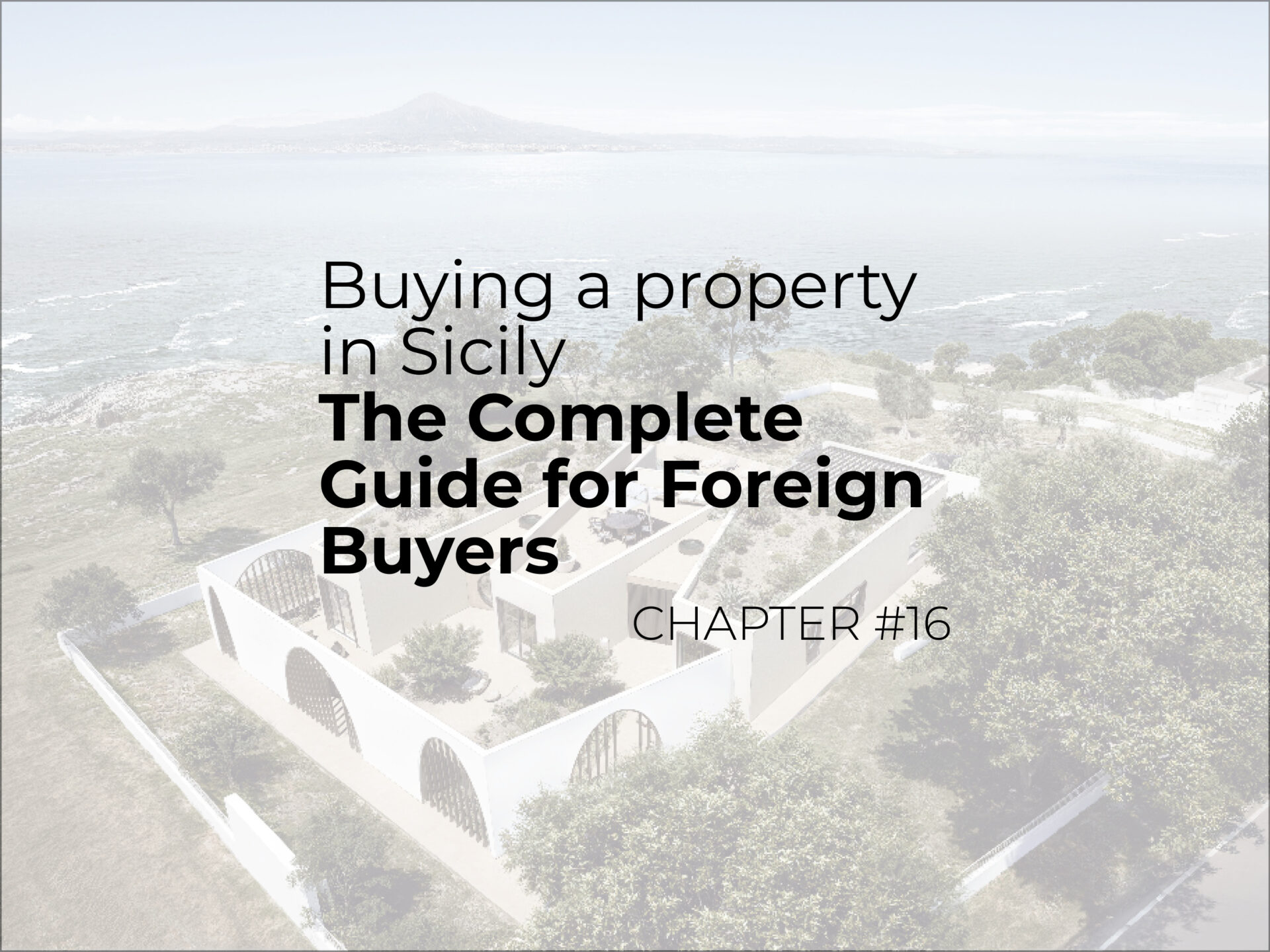
A clear, professional guide from a Sicilian architect, so your dream stays beautiful, feasible, and hassle-free.
BUYING, BUILDING AND RENOVATING IN SICILY : A FULL GUIDE
This article is part of an ongoing guide for foreign buyers who want to buy, build, or renovate in Sicily with confidence.
Chapter 16
Rural, coastal and Etna contexts—what changes, what to check, and how to make ownership feel calm, durable and low-friction over time.
Maintaining a house in Sicily: what foreign owners should plan
If you are maintaining a house in Sicily as a foreign owner, the goal should not be constant supervision. The goal should be predictable routine. A well-designed Sicilian home does not need drama. It needs the right maintenance profile, the right materials, a sensible seasonal checklist, and a local support structure that keeps small issues small.
Many foreign buyers worry about ownership after the purchase: what happens when the house is empty for weeks, what the coast does to external materials, how quickly vegetation grows in the countryside, or whether Etna dust and seasonal swings create extra work. These are the right questions. The reassuring answer is that most of the burden comes not from Sicily itself, but from poor planning, fragile detailing, and lack of routine.
A calm house in Sicily is usually the result of three things: durable design decisions, a simple maintenance system, and written records that make future interventions easy.
Why maintenance in Sicily should be predictable, not stressful
Owning a home in Sicily should support your life, not consume it. The climate is strong but understandable: intense sun, occasional driving rain, salt air near the coast, rapid vegetation growth in rural contexts, and seasonal patterns that affect shutters, drainage, filters, seals, roofs and external finishes.
The key is to stop thinking about maintenance as ‘repair after failure’ and start thinking about it as a light operational rhythm. In practice, this means seasonal inspections, a home file, and materials selected for the actual location of the property not for an abstract image of Mediterranean style.
For overseas owners, simplicity matters even more. The house must be easy to open, easy to close, easy to inspect, and easy to hand over to a trusted local contact when needed.
Maintaining a rural house in Sicily
Rural house maintenance in Sicily is usually defined by drainage, vegetation, roof behaviour, insects, humidity management, and access. Even a beautiful country property can become tiring if drainage was never designed well, if external surfaces hold moisture, or if the garden grows faster than the ownership system can manage.
The most common rural maintenance priorities are:
- roof and gutter inspection before and after wetter seasons;
- surface drainage and run-off management around the building;
- vegetation control near walls, paths, terraces and retaining edges;
- opening/closing routines if the house is left unused for long periods;
- filters, pumps, tanks and any off-grid or semi-independent systems;
- easy service access for local trades and maintenance teams.
For holiday homes or retirement homes in the countryside, the smartest design choice is often not the most dramatic one. It is the detail that makes inspection, cleaning, access and replacement simple ten years later.
Maintaining a coastal house in Sicily
Coastal home maintenance in Sicily is often less about dramatic failures and more about accelerated ageing. Salt exposure affects metalwork, fixings, hinges, external lighting, railings, gates and even some stone and render details depending on exposure and specification.
For a coastal house, foreign owners should expect a more disciplined check of:
- corrosion-prone elements such as hinges, railings, fasteners and external equipment;
- protective finishes and repainting cycles where relevant;
- seals around windows and doors exposed to sun and wind;
- shading systems, pergolas and external joinery;
- terraces and balconies, especially where water and salt combine;
A good coastal maintenance strategy begins at design stage. Stainless steel quality, paint systems, detailing that sheds water correctly, and easily replaceable components are not luxuries they are what makes coastal ownership sustainable in real life.
Maintaining a house near Etna
Etna-area property maintenance has its own logic. Depending on altitude, microclimate and exposure, owners may need to think about stronger seasonal variation, wind, ash or dust episodes, and how external air, filters and roof surfaces behave over time.
Etna properties are often beautiful precisely because they sit in strong landscapes. But that also means maintenance should include:
- roof and rainwater element checks after ash or dust events;
- filter cleaning and ventilation system checks where applicable;
- external cleaning routines that are realistic, not excessive;
- seasonal review of thermal comfort, condensation risk and heating/cooling settings;
Again, the principle is not fear. It is preparedness. A house near Etna can be calm and durable if systems are chosen well and the owner understands the local rhythm.
Seasonal opening and closing routines for holiday homes
Holiday home maintenance in Sicily depends heavily on whether the property is occupied year-round, used seasonally, or rented to guests. A house left empty for weeks needs a different routine from a primary residence.
For many foreign owners, the single most useful habit is a written opening and closing checklist. That checklist should cover shutters, windows, ventilation logic, water isolation strategy where appropriate, appliance shutdown, humidity-sensitive rooms, filters, drains, and quick visual checks on leaks or external movement.
A simple seasonal routine often prevents the most annoying ownership problems: stale interiors, small leaks becoming bigger leaks, unexpected humidity build-up, blocked drains, and avoidable service calls.
If the house is also a short-let or holiday-rental asset, maintenance becomes part of reputation and return on investment. Durable finishes, spare parts kept on site, easy-to-clean details, and a dependable local support network matter more than fragile decorative choices.
Design choices that reduce maintenance over time
One of the most overlooked truths in residential architecture is that maintenance is largely designed in or designed out. The wrong material in the wrong exposure, the wrong drainage logic, an over-complicated external detail, or a fashionable but fragile finish can make an otherwise good property frustrating to own.
Design choices that generally reduce maintenance in Sicily include:
- durable, repairable external materials suited to the exact exposure;
- good water-shedding details and simple drainage logic;
- external shading designed as architecture, not as an afterthought;
- serviceable systems with filters and controls that can be checked easily;
- components that can be replaced locally without bespoke delay;
- joinery, finishes and fittings chosen for everyday life, not only for photographs.
For foreign clients, this is where an architect adds long-term value. The goal is not only to make the house beautiful on completion day, but to make it easier to own for years afterwards.
The home file and the local support network
A home in Sicily is much easier to manage when it comes with a proper home file. That file should include manuals, warranties, paint codes, product references, maintenance notes, certificates, drawings where relevant, and service contacts. It should also make clear what was installed, when it was serviced, and who to call first.
The second half of calm ownership is a local support network. Even a low-maintenance home benefits from trusted people who can inspect, ventilate, reset systems, deal with small issues, or coordinate seasonal opening and closing. For overseas owners, this is often the difference between confidence and constant worry.
In practical terms, the best ownership model is simple: design for durability, organise the home file properly, and create a local system before you urgently need one.
Milestones
> Identify your maintenance profile: rural, coastal, Etna, year-round use, seasonal use, or rental use.
> Create a seasonal inspection routine for roof, drainage, filters, humidity, shutters and externals.
> Define opening and closing routines if the house will remain empty for periods.
> Organise the home file with manuals, warranties, certificates, product references and service contacts.
> Review material durability and replace fragile details where long-term maintenance is likely to be high.
> Set up a trusted local support network for checks, call-outs and seasonal operations.
> If renting, plan turnover controls, spare parts, and simple operating instructions.
How Bureau69 Architects supports you
> Durability-led design choices that reduce maintenance over time.
> Context-specific guidance for rural, coastal and Etna-area properties.
> Maintenance and ownership reviews for overseas clients before or after purchase.
> Support in creating a practical home file and ownership routine.
> Advice on rental-ready specification, replacements and serviceability.
> Long-term architectural support for upgrades, maintenance planning and calm ownership.
If you own, or are about to buy, a house in Sicily, message me on WhatsApp for a Maintenance & Ownership Review. I’ll help you identify the right routines, risks and upgrades, then we’ll schedule a call.
FAQ
Is maintaining a house in Sicily difficult?
Not necessarily. Maintaining a house in Sicily becomes straightforward when the property is designed well, checked seasonally, and supported by a simple written routine.
What maintenance problems are common in rural Sicily?
Drainage, vegetation, humidity, roof checks, service access and systems such as tanks or pumps are common rural priorities.
How do you maintain a coastal house in Sicily?
Focus on corrosion-prone elements, protective finishes, seals, terraces, and all exposed external components affected by salt and wind.
What should foreign owners check when the house stays closed for weeks?
Use a written opening and closing checklist covering ventilation logic, leaks, humidity-sensitive rooms, drains, shutters, filters and visual inspections.
What should be in a home file for a Sicilian property?
Manuals, warranties, certificates, product references, paint codes, service contacts, maintenance notes and key drawings where relevant.
How do I make a Sicily house easier to maintain and rent?
Choose durable materials, avoid fragile detailing, keep spare parts on site, simplify systems, and build a reliable local support network.
Reading the guide
< 15 — Completion and handover: documents, certificates and the home file
> 17 — Legal and tax overview for foreign buyers: what to ask and how to stay safe